
UK Immigration in 2026: A Changing Landscape for Businesses and Individuals
By Rose Temple, IAA Level 1 Immigration Adviser
UK immigration has rarely moved as fast as it is moving now. In the space of a few months the government has reshaped how sponsored workers are paid, raised the bar for settlement and the English language, shortened the protection granted to refugees, and set out a vision that would double the time most people wait before they can settle here. For employers who depend on international talent, and for individuals and families building a life in the UK, the rules are being rewritten in real time.
This article sets out what has actually changed, what is coming next, and what it means in practice. Crucially, it separates firm rules already in force from proposals still under consultation, because that distinction matters enormously when you are making decisions about your workforce or your future.
The direction of travel: from qualifying to earning
Almost every recent change traces back to the government’s 2025 white paper, Restoring Control over the Immigration System. The philosophy behind it marks a genuine shift. For years the UK system worked on a broadly simple premise: meet the requirements of a route, spend the qualifying time here, and settlement followed. The emerging system is built instead around three ideas: higher thresholds to enter, much tighter compliance for the employers who sponsor workers, and longer, more conditional routes to settling permanently.
For businesses, this means immigration can no longer sit in a drawer to be opened once a year at visa renewal. It has become an ongoing compliance discipline that touches payroll, record-keeping, and HR. Where legal and immigration questions overlap, as they increasingly do, joined-up advice matters. Our business law services and immigration advisory team are built around exactly that overlap.
Earned settlement: the ten-year question
The single largest proposed change concerns settlement, also known as Indefinite Leave to Remain (ILR). In November 2025 the Home Office launched a consultation, A Fairer Pathway to Settlement, which closed on 12 February 2026. At the time of writing the responses are still being analysed and no draft rules have been published.
Under the proposed model, the baseline qualifying period for settlement would double from five years to ten for most people. Settlement would no longer rest on residence alone. It would be assessed against four pillars: suitability (good character), integration, contribution and residence. The baseline could then be adjusted up or down, with only the single most significant increase and the single most significant reduction applied in any case, and increases taking precedence over reductions.
Among the proposals being discussed:
- Faster routes for some. High earners (taxable income of at least £125,140), as well as Global Talent and Innovator Founder visa holders, could potentially settle in as little as three years. Reductions have also been floated for public service, volunteering, higher-level (C1) English, British citizen family members and BN(O) status holders.
- Longer routes for others. Use of public funds, overstaying, unlawful arrival or initial entry as a visitor could extend the qualifying period.
- A retrospective reach. The consultation proposes that the longer baseline would also apply to people already in the UK who have not yet obtained ILR, which is the most contested element by far.
That last point has driven significant public response. Petitions opposing the change passed hundreds of thousands of signatures, and a Westminster Hall debate in February 2026 followed. The government has confirmed it intends to proceed in principle, while stressing that transitional arrangements for those already here remain under consultation.
The essential takeaway is one of timing. None of this is law yet. The existing five-year and ten-year settlement routes remain fully in force, and they continue to apply until new rules are laid before Parliament. Anyone approaching eligibility under current rules has good reason to understand their position now rather than later. If you are weighing up where you stand, our immigration advisory team can help you map your timeline against the rules as they actually are today.
What has already changed in 2026
Behind the settlement headlines, a Statement of Changes published on 5 March 2026 brought in a series of measures that are already biting. The most important for employers and applicants are set out below.
- Salary checked in every pay period. From 8 April 2026, the salary of a sponsored Skilled Worker must be paid correctly within each pay period, rather than simply averaging out across a year. Pay is assessed across a rolling three-month window (for monthly or less frequent pay) or a twelve-week window (for more frequent pay). Regular, level salaries are largely unaffected, but irregular pay, shift weighting, and front-loaded or back-loaded packages now carry real compliance risk.
- Higher English language requirements. The level required for settlement in most categories rises from B1 to B2. The change took effect on 26 March 2026 but, thanks to transitional provisions, applies to settlement applications made on or after 26 March 2027. The B2 standard already applies to new Skilled Worker, Scale-up and High Potential Individual applications from 8 January 2026.
- A new “visa brake”. From 26 March 2026, Afghan nationals can no longer apply for entry clearance as a main applicant on the Skilled Worker route, and nationals of Afghanistan, Cameroon, Myanmar and Sudan can no longer apply for entry on the Student route. The duration of this temporary measure is not yet known.
- Shorter refugee protection. For claims decided on or after 2 March 2026, grants of refugee status and Humanitarian Protection now last 30 months rather than five years, with a new “active review” of whether return home has become safe.
- Suspended sentences now count. A custodial sentence of 12 months or more is now mandatory grounds for refusal even where the sentence was suspended, for convictions on or after 22 March 2026. There are no transitional provisions, so this can affect existing visa holders at renewal or when applying for settlement.
Costs are rising too. Most immigration, nationality and passport fees increased by roughly 6 to 7 per cent from 8 April 2026. A selection:
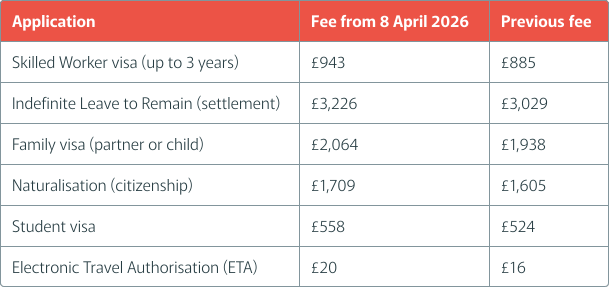
For a full picture of what an application is likely to cost, alongside our own transparent, fixed-fee structure, see our fees page.
The compliance squeeze on employers
If there is one theme employers cannot afford to ignore in 2026, it is enforcement. The number of UK businesses losing their sponsor licence tripled to around 3,100 at the end of 2025, the highest figure on record, with more than 1,500 licences revoked between October and December alone. Construction, social care, hospitality, and retail have drawn particular attention, with underpayment, poor record-keeping and worker exploitation among the most common triggers.
Just as significant is how enforcement now happens. UK Visas and Immigration increasingly cross-checks data across government, drawing on HMRC, PAYE and Companies House records rather than relying on physical site visits. The practical effect is that a minor slip in a salary calculation or a missed reporting duty can surface quickly and carry serious consequences.
Recent guidance has also added to what sponsors must do:
- Read the guidance in full. Sponsors are now expected to read the complete sponsor guidance, including Parts 1 to 3, the appendices, route-specific guidance and the glossary, and to keep up with frequent updates. Checking the Sponsor Management System message board monthly is a sensible habit.
- Inform workers of their rights. Sponsors must now ensure their workers understand their employment rights, from the National Minimum Wage and working time rules to pension auto-enrolment, statutory leave and how to raise a grievance.
- Watch the right to work pendulum. A March and April expansion that appeared to require right to work checks on “directly engaged” non-employees such as contractors was rolled back on 20 May 2026, reverting to the previous position. Record-keeping duties, however, were widened so that sponsors must now retain right to work evidence for all employees, not only sponsored staff. The eVisa is also now the sole proof of status in most cases.
- Prove you genuinely trade. Tighter tests now apply to whether a business is genuinely operating or trading. Applications can be refused where a company looks like it exists mainly to bring someone to the UK, and the Home Office has signalled a continued clamp-down on self-sponsorship and “circular trading” between linked entities.
The right to work reversal is a useful illustration of the wider point: sponsor guidance changed three times in three months. Treating sponsorship as a one-off administrative task is no longer viable. It is an ongoing programme that rewards regular review. If your organisation employs international talent, our team can help you understand your duties and keep your processes current. Speak to us about employer immigration support.
Travel: the ETA is now fully live
For anyone bringing overseas staff, clients or partners into the UK for meetings or short visits, the Electronic Travel Authorisation (ETA) is now unavoidable. From 25 February 2026 the introductory grace period ended, so non-visa nationals must hold an approved ETA before they travel, and carriers are required to refuse boarding where status cannot be confirmed. The ETA costs £20, lasts two years or until the passport expires, and should be factored into any inbound travel planning. Where a visit goes beyond what an ETA permits, our business visitor visa guidance can help you get the route right before anyone books a flight.
What this means in practice
For employers:
- Audit pay and records now, with particular attention to anyone on irregular or variable pay against the new per-pay-period rules.
- Budget for higher fees and for the uncertainty around settlement, which may affect how you retain key people who were counting on a five-year route.
- Give someone clear ownership of sponsor compliance, including monthly monitoring of guidance updates.
For individuals and families:
- Work out whether your plans sit under the current rules or potential future ones and consider timing accordingly.
- Prepare for the higher English language standard early rather than at the last moment.
- Keep careful records of your residence and any absences, and have applications checked before submission to avoid refusals and lost fees.
How Temple & Green can help
At Temple & Green we do not have clients, we have partners. Led by IAA Level 1 regulated Immigration Adviser Rose Temple, our team helps businesses and individuals navigate the early and practical stages of the immigration journey with clarity and confidence, all through a transparent, fixed-fee structure. That includes guidance for employers on visa routes and supporting international staff, document and application checking, help understanding Home Office procedures and decisions, and business legal support that sits alongside your immigration needs.
In a landscape this changeable, the value of clear, current advice is hard to overstate. If any of the changes above affect you or your organisation, get in touch and we will help you move forward with a plan that fits the rules as they stand today, and the ones likely to follow.
This article is general information, current as at June 2026, and is not legal advice. UK immigration rules change frequently and often at short notice. For advice on your specific circumstances, please contact Temple & Green. Temple & Green Limited is authorised and regulated by the IAA (Ref No. F202538447).